.png)
Why the quietest rooms
often feel the most luxurious.
A short essay on stillness as the principal currency of the contemporary interior — and why a great deal of restraint is now what reads, almost immediately, as luxury.
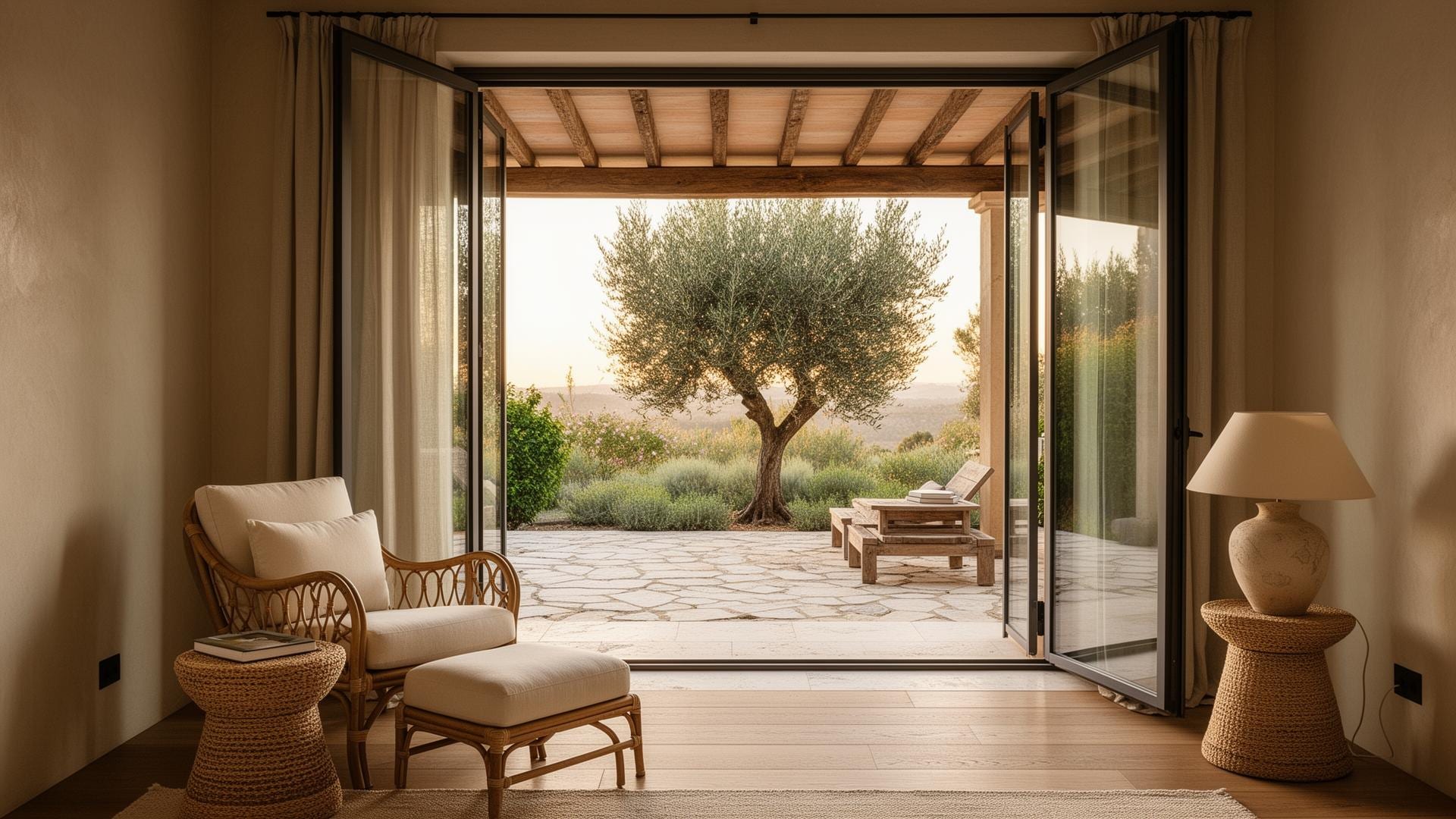
The first thing one notices about the kind of houses being quietly built for serious clients now is that they are quiet. Not in any silent, austere way — these are not monastic interiors and they are not cold — but quiet in the older sense of the word, meaning composed. The room does not push at you. It is not trying to make an immediate visual case. It allows the eye to settle, and then it allows the body to settle, and for a long time afterwards nothing in the room asks for further attention.
This is, almost certainly, a response to the noise of everything else. Contemporary life is, by any measure, the most visually loud condition human beings have ever lived in. Phones are luminous. Cities are saturated in signal. Every surface in public space is now, in some small way, advertising. The interior — the only environment most of us have any real authority over — has become, by direct consequence, a place to put the volume down.
Refuge, not statement.
The change in what wealthy clients are actually asking for has been quite specific. Ten years ago the brief tended to involve a statement piece — a chandelier, an oversized art wall, a dramatic stair. Five years ago the brief began to soften. The word that comes up now, almost unprompted, is sanctuary. The room is to be a place to come back to. The light is to be even. Sound is to be absorbed. There is to be, ideally, nothing in the room that the eye has to negotiate.
What is being asked for, in other words, is emotional refuge. The interior is being made to do work that older interiors rarely had to do — to act, in a meaningful way, as a counterweight to the rest of the day. Designers describe this openly. The drawing room is to receive the body in the evening; the bedroom is to give it back in the morning; the rooms in between are to hold it without demanding much in return.
Stillness is the form luxury takes when everything outside the house has begun to shout.

The architecture of calm.
A quiet room turns out to be a much more architectural proposition than a noisy one. Stillness is engineered. Light has to be filtered, not blocked. Sound has to be absorbed by fibre and softened by surface, not deadened by acoustic panel. Sightlines have to be considered — what one sees from the chair one actually sits in, not from the angle of the most flattering photograph. The room has to be designed for the body more than for the eye.
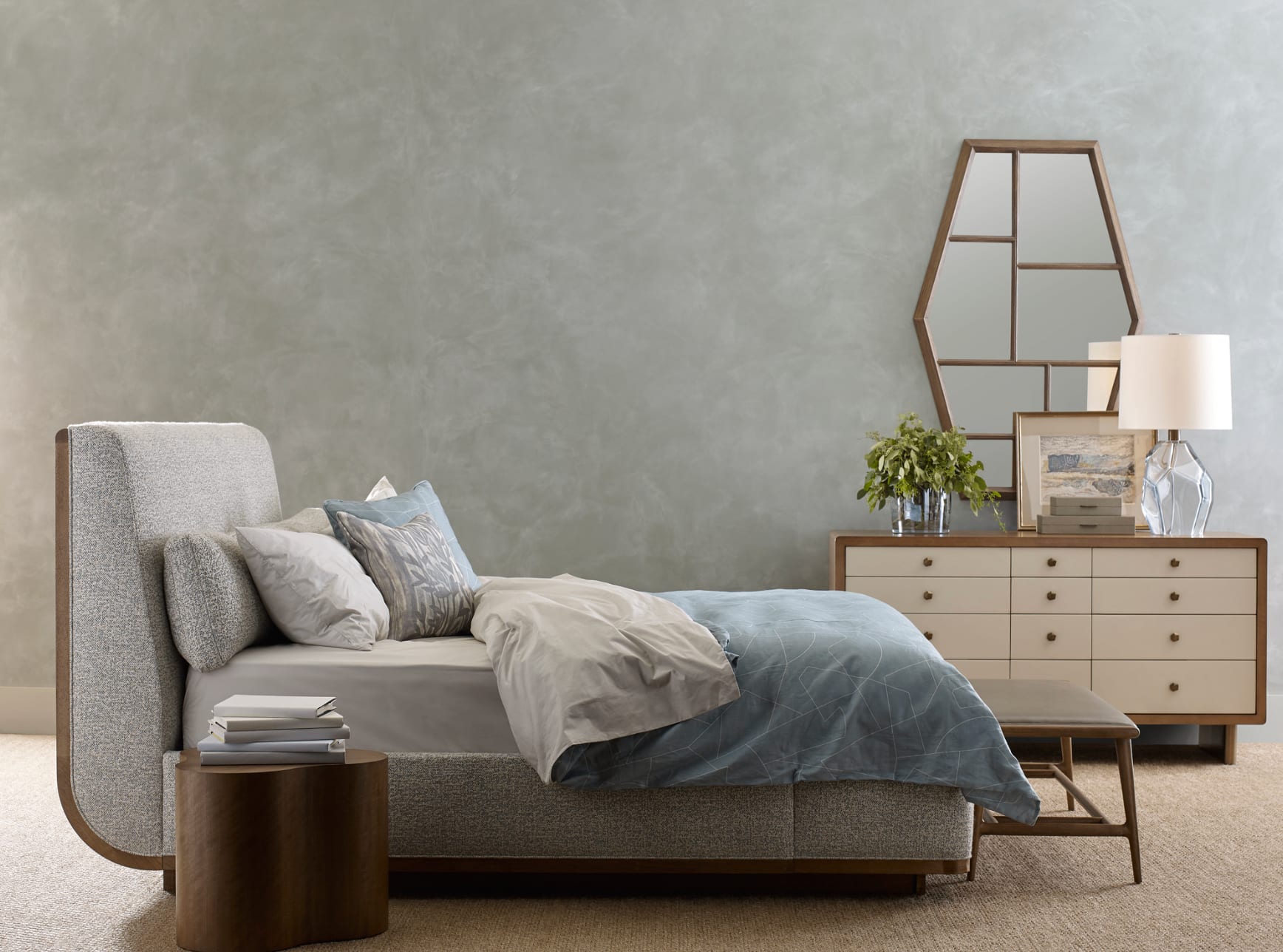
This is partly why the materials of the calm interior are so consistent. Hand-finished plaster instead of paint, because plaster absorbs and softens. Wide-board hardwood instead of stone, because hardwood holds warmth. Hand-loomed natural fibre at the windows instead of a flat-weave panel, because the fibre filters light into something one can actually live inside. Wool and linen instead of synthetic blends, because they take sound out of the air. None of these decisions is incidental. Each is part of building a room that is quiet before it is anything else.
Restraint as a palette.
The palette of the calm room is rarely as narrow as it first appears. Within the small range of stone, plaster, oat, linen, parchment, oxidised bronze and softly weathered hardwood there are dozens of distinct registers, and the rooms that work tend to be using six or seven of them at once. The discipline is in keeping all the registers within a single tonal family. The room does not contain any colour that would be the answer to a question.
A restrained palette is restful for a specific reason. The eye, given a small range, stops looking for difference. It stops categorising. It moves through the room more slowly and rests on the materials themselves — the grain of the oak, the weave of the grasscloth, the small irregularities in the plaster — rather than on the relationships between objects. The room is, paradoxically, more interesting as a result, because there is more time for any single thing in it to be looked at.
The emotional intelligence of the quiet room.
What the calm interior is doing, more than anything else, is attending to how the people who live there are likely to feel. This is a relatively recent shift in how interiors are designed at the top of the market. The earlier model assumed that an interior’s job was to demonstrate something — taste, wealth, period knowledge, the designer’s signature. The current model assumes that an interior’s job is to absorb something — the day, the noise, the accumulated low-level pressure of contemporary work — and to return its occupants to themselves.
This is emotional intelligence in the literal sense. The room is being designed to do something for the nervous system. It is no accident that the same materials keep recurring across the otherwise quite different schemes of designers working this register. Hand-loomed natural fibre, low-sheen hardwood, hand-finished plaster, raw linen, deep wool — these are the materials that the body responds to most consistently. The aesthetic and the physiological are, in this register, almost the same thing.
Why this reads as luxury.
The reason quietness now reads, almost immediately, as luxurious is not difficult to track. The materials that produce it are slow to make and slow to install. Hand-finished plaster is a matter of skilled labour over days, not a tin from a shop. Hand-loomed natural fibre is dependent on small mills working at small scales. Bench-made hardwood furniture is the product of weeks of handwork by trained craftsmen. None of this can be accelerated. None of it photographs as ostentation, but all of it is, in the most literal sense, expensive — in materials, in craft hours, in the patience required to do it properly.
The houses that produce the quiet room are, almost without exception, the long-running workshops that have always worked at this pace. They were quiet before quietness was luxurious, and they will, in all likelihood, still be quiet when the next register comes round. The current alignment is a happy one — the slow craft and the contemporary temperament finally pulling in the same direction — but the craft, in the workshops that matter, is not new.
What is new is the willingness of the client. A generation of buyers conditioned by saturation has begun to find that the most interesting room they walk into is, increasingly, the most still one. The quietest room in the house tends to be the room they go back to. And the rest of the brief, in the end, follows from there.
The luxury, now, is the absence of pressure. The quiet room is the most considered room in the house.